

Our Animal Friend

Our cat died. The way he did was not pleasant. I won’t relive it here, but I keep reliving it. He had a big presence; it filled our house and our neighbourhood. Everyone knew him. Many things remind me of him, and I keep forgetting he’s not here.
I can't wait for him to jump on my chest in the morning, kneading on my neck; petting him half asleep. I can't wait to let him outside, first thing upon waking, starting my day by feeling his felicity for adventure. I can't wait to see him come back, as he speeds up a little when he spots me, always meowing with delighted surprise, and then greet him with a loud cheer — Snuggies!
Above all, I can’t wait for when time stops, while he interrupts my work and sits on my laptop, just to be with me.
No, these are no longer possible: I remember he died, followed by the shock of how. It hurts, that gap, of still feeling him here and the reality that he’s gone. Each recalling is a return to the moment Camille and I found him, a moment that felt so unreal. His body lying there without his presence, and the perfect freedom that came from it.
I’m learning about grief — “love with no place to go” — emotions that reach out for what’s no longer there. It starts with separation denial, a protest against reality, that invokes a “this isn’t real” feeling, but then the scene replays, and the emotional intensity comes: a pressing inward, as if digging to create an internal well, a most tender pain that keeps deepening and widening.
I oscillate between wanting to run from it, and then giving way to it. Numbing it, then holding it. Doing something, then being with nothing — natural movements that come from the digging.
There are outdated models, like Kübler-Ross's five stages of grief, whose sequence was never empirically validated. Newer ones, like the dual process model, state that bereavement weaves between loss-orientation, being with the emotions that come from the loss, and restoration-orientation, rebuilding life from the loss.1 The model’s original framing misses a third element: meaning-orientation — why did this have to happen, especially to such an innocent being?
“Disenfranchised grief,” grief that society does not fully recognize or support, includes the death of a former spouse, an extramarital partner, or one’s pet. One needs to mourn, and know how to do it well, to build capacity that holds the intensity, and whatever Godly wisdom comes from it. Without this, meaning-making turns into crazy-making, a ruminative mess that leads to a premature resolution.
Fools will say it’s “just a pet.” That’s not true. They are our animal friends, as Camille insists on calling them. Their bond offers something unique: no entanglements common to human relationships. They reflect our innocence back to us, an inner purity we can no longer express to others.2 Failing to properly grieve them brings an injustice to the soul.
I’m writing now to grieve and honour our friend. His memory deserves to be joyous, because that’s how he lived.
***
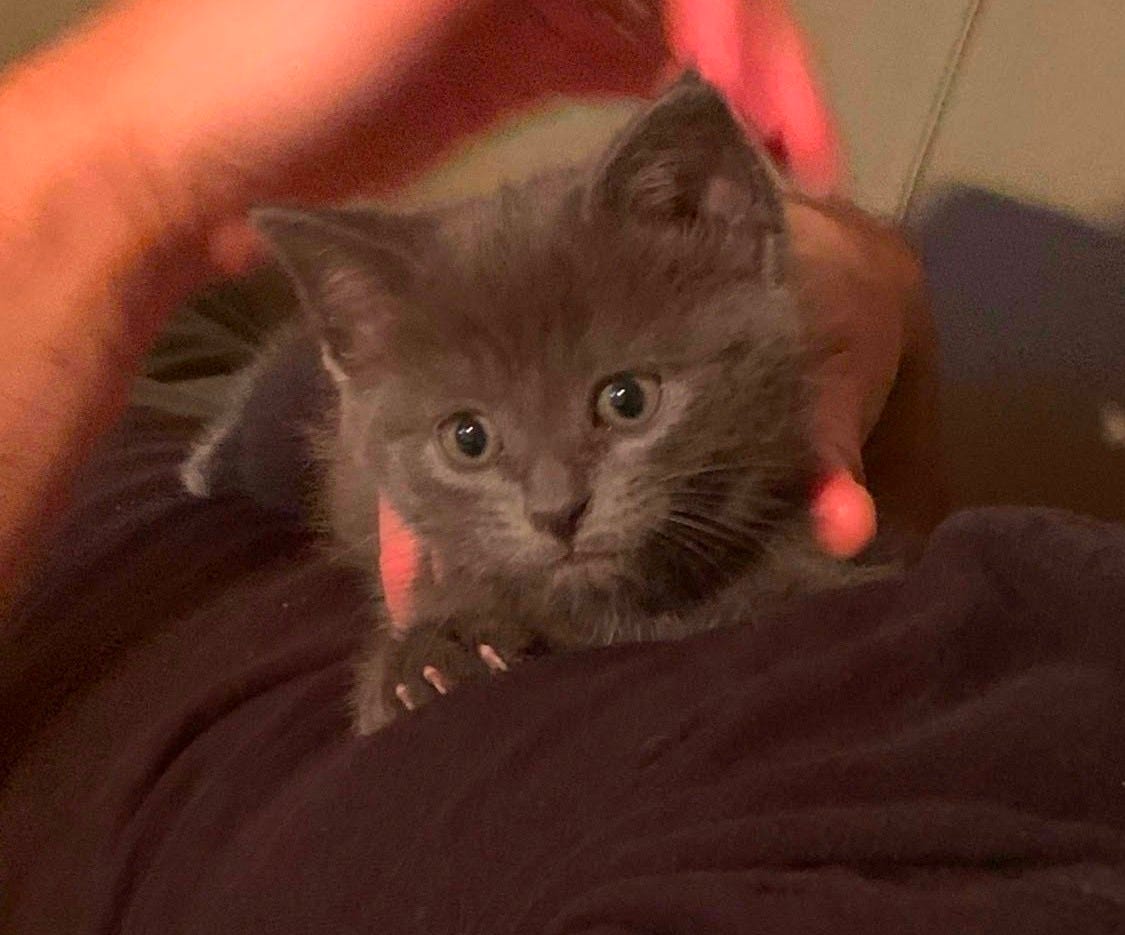
He was always Camille’s guy. She found him. Or he found her. It was three years ago; she was at work looking at the local animal shelter services’ website, and saw him on the adoption page. On her lunch break she visited him; he got up on two legs to greet her, then fell down, and that was it. She had to take him.
We were told by the shelter that he was found roaming the streets. This little kitten, who couldn’t be older than two months, escaped from God knows where, venturing the city on his own. I think he was looking for Camille, his soul attuning to hers. His escape and subsequent capture were mere ploys, his way to find her.
I was skeptical at first. We already had a cat, but Camille was so sure. The shelter gave him the name Snuggle Bug, which she kept. After we brought him home there was nothing snuggly about him, as he crawled on my head and tried to eat my hair. What kind of feral cat was this? But he calmed down, and aggression was balanced by affection, and the namesake came true: all he wanted to do was cuddle.
He was unusually present. When he looked at us, he locked in: no looking away, no blinking. It was intimidating, like he knew something we didn’t. I broke eye contact first multiple times. At certain points, he was looking around the room as if he were tracking something. I tried quieting my mind, squinting to look where he was. I could be deluding myself, but a few times I glimpsed what he did — faint things dancing in the air, moving like stingrays across the room.
Something felt spiritual about him. Last summer, we thought we lost him. He did not return home one evening. We put up missing posters on the street and postings on websites like PawBoost, and suffered through prank calls and scammers. It approached the two-week mark, the date we agreed to move on and take down the postings. Then something otherworldly happened.
On PawBoost, a random man with no photo — who, from his Facebook page, seemed to mainly pray for missing children — asked St Gertrude of Nivelles, the patron saint of cats, to intercede on our posting.
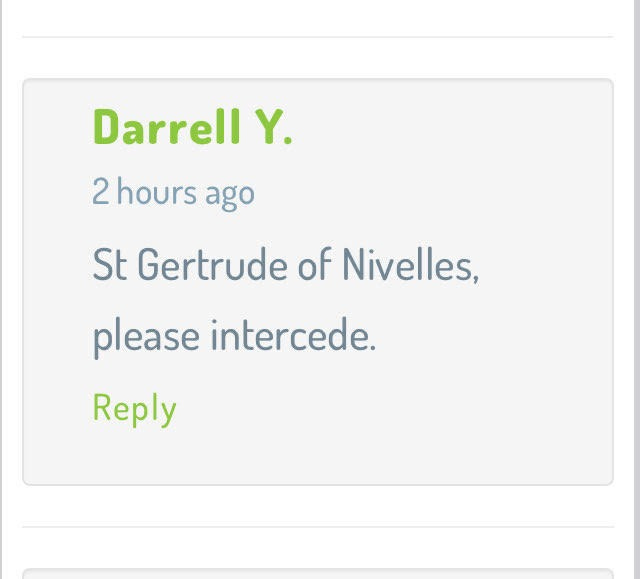
An hour later, Snuggle Bug returned. A moment that felt so unreal. It’s hard to describe, but everything seemed cloudy white with fierce light behind it. It was intensely joyous. The heaviness we felt over the last few years dropped, and life felt like it could be miraculous again.
That joy stayed with us. Every time I saw him, even if only five minutes had passed, I’d say to him: “We miss you so much!” His affection was unbounded. He burst into my office, jumping on my desk, punching my head with his. He just kept going. I felt so light after, drunk on love.
A few months ago I took a photo that breaks my heart. Camille was sitting on my desk, wrapping her arms around him, and he was looking at her, away from the camera. She looked like an innocent girl holding her fur baby. After it was taken, we looked at it and both felt sad. Looking at it now brings immediate tears. Thinking about it now brings me tears.
It’s the perfect photo. It contains so much. That mirror of innocence between them. A timeless purity that will last forever. This obvious, spiritual truth is coupled with the reality of this world: everyone we love will die, and, maybe most painful of all, our innocence feels like it dies with them. My new spiritual practice is to be with that photo, as it holds both these truths together.
It breaks my heart. And breaks it open.
The memory when we found his body, that was just his body, not really him.
The real him is remembered in his escape to find Camille, his surging back into our lives with light penetrating the clouds, and the way he love-punched our heads with his each day.
That’s him. Snuggle Bug. Our animal friend: present and free.
When you were here, you were fully here.
The most generous gift.
One we’ll long relive.

I'm moved to write regularly again. Thanks for your patience. You can support my writing by becoming a subscriber.
I’ve also re-enabled likes and re-stacking. Feel free to share if you sense this will benefit someone. We’ll all try not to get pulled, together.
Lastly, thanks go out to Alexander Ebert, whose beautiful song kept me company while I wrote this piece.
Margaret Stroebe and Henk Schut, “The Dual Process Model of Coping with Bereavement: Rationale and Description,” Death Studies 23, no. 3 (1999): 197–224.
This argument is developed further in Wallace Sife's The Loss of a Pet.
Love this post so much from an unashamed cat lady. Matcha and I send our love. I know Snuggle Bug’s spirit is free. And your writing is a beautiful tribute. I bet he sends you a sign ;)
Strongly resonate with your sharing the grief and love. I'm not familiar with a model of grieving that exactly describes what I have felt most "growth inducing" for me, and which I am also taking from your essay, Peter: allow your consciousness to "rest at" the place of love, the place that hurts soooo very much if you stay too long, because it fills your heart with a roaring certainty that soon, too soon, everything must perish, and because it must perish, everything is precious, so very, very precious -- if only we can pause long enough to feel into the predicament of fragility and returning to formlessness. It creates such a strong urge to celebrate and mourn at the same time, because both come from the same source: love. Thank you!