Solarpunk vs. Archeofuturism

It’s clear something is shifting worldwide. Near the bottom of that shift are worldviews.
A robust worldview has a timeline: a story of where we were, where we are, and where we are heading. Many timelines are quite intense, catastrophic or eucatastrophic, where an event, or the event, will change everything for the worse or for the better.
Not many worldviews have timelines that see beyond the event that changes everything, as they argue it is impossible to know.
The following events are happening, or are just about to happen, according to the worldviews in play:
WWIII
5D Shift
Disclosure
Second Coming
The Great Reset
Climate Apocalypse
Technological Singularity
The last event has many influential people who believe in it. The technological singularity refers to a point at which artificial intelligence surpasses human intelligence, triggering exponential technological advancement without human input and rapidly progressing beyond human control and comprehension.
In 2012–2013, a survey of AI researchers conducted by philosophers Nick Bostrom and Vincent C. Müller predicted that the singularity would occur around 2040–2050. The famed transhumanist Ray Kurzweil estimated that it would happen by 2045. More recently, Dario Amodei, the CEO of Anthropic, has suggested that the singularity could arrive as early as next year, while Sam Altman, the CEO of OpenAI, argues that the “gentle singularity” has already begun and that by 2030 we will see the fruits of abundant intelligence.
Despite Altman’s techno-optimism, if such a singularity emerges as it is said to, no one really knows what lies beyond its event horizon, since it is, in theory, utterly beyond human understanding. However, there are skeptics of the singularity who see it as a muddled concept, such as technologist Jaron Lanier, who views it as a kind of death denial and a new religion for the techno-optimists.
In any case, with or without the recursive self-improvement of the singularity, it is undeniable that we are in an age where science-fiction-tier technologies are being introduced: AI-generated media, augmented reality, holographic displays, neural interfaces, quantum computing, engineered living materials, advanced robotics… sexbots (!!!)
Things are going to get strange, and technology will seem like magic, which, according to science fiction writer Arthur C. Clarke, any sufficiently advanced technology is.
“Any sufficiently advanced technology is indistinguishable from magic.” - Arthur C. Clarke
The main question now is: how will this techno-magic be harnessed? If it isn’t harnessed wisely and is wielded wildly by fools, the dystopian science fiction writers (aka techno-prophets) who have long warned us of dreary timelines may yet be proven right.
However, there are at least two timelines that, as I see it, offer imaginal responses to harness this techno-magic.
A Tale of Two Timelines
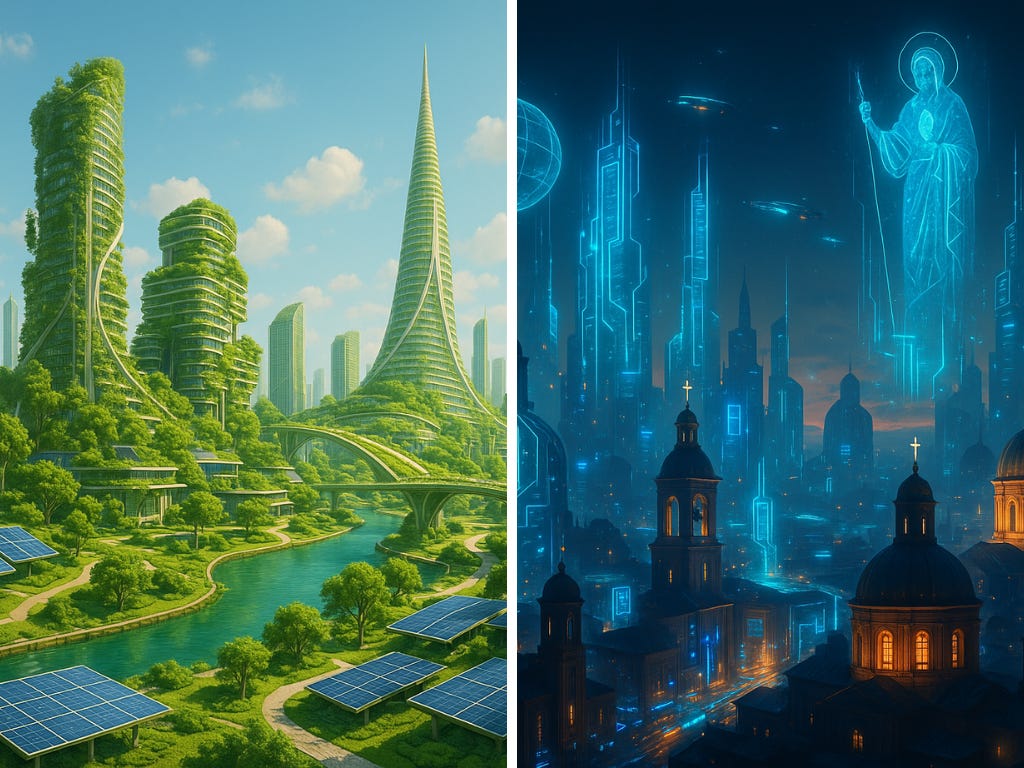
The two timelines, not unfolding from present worldviews but from imaginaries glimpsed through more artistic means rather than theoretical musings, are solarpunk and archeofuturism. The first timeline appeals to those on the political left and who are culturally “woke,” while the other appeals to those on the political right and who are culturally “based.”
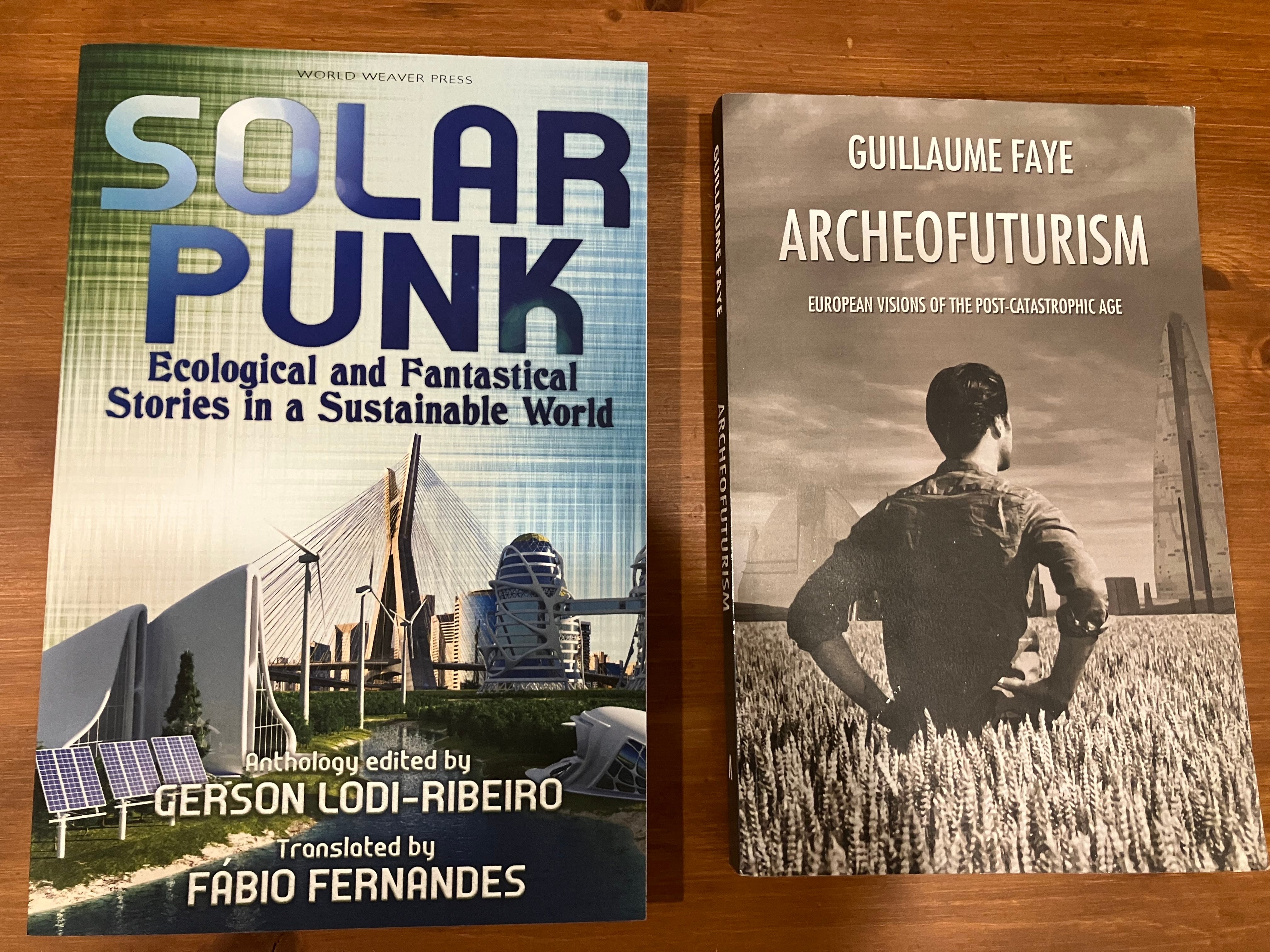
Solarpunk, starting as a literary genre, has since evolved into an artistic movement that envisions a hopeful future where technology and nature coexist in harmony. The “solar” refers to solar and other renewable energies, while “punk” embodies the DIY ethos and a post-capitalist, decolonial countercultural spirit. At its core, solarpunk seeks to create regenerative societies that are socially just.
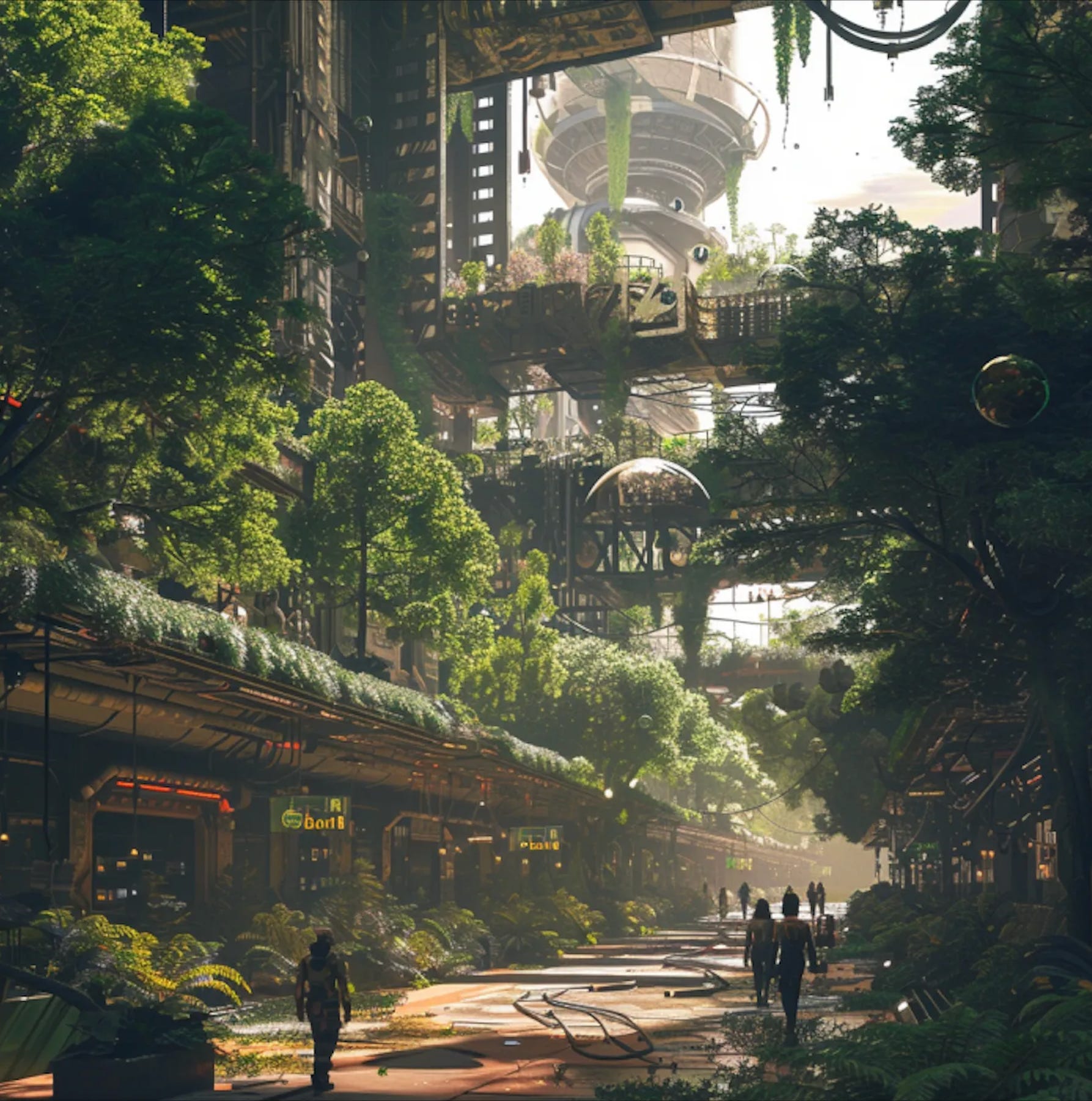
While the focus is on advanced technology, the core value is nature, with the aim of regeneration (restoring biodiversity, cleaning waterways, rebuilding soil health, etc.). Additionally, it is associated with a “woke” pluralism: an embrace of different identities and lifeways, communing together in conviviality.
The quintessential visual representation of solarpunk is the “Dear Alice” video. Originally created by Chobani to sell Greek yogurt, the decommodified version of the video better tells the story of the solarpunk timeline.
Archeofuturism, in contrast, was coined by the “French New Right” thinker Guillaume Faye in his 1998 book Archeofuturism: European Visions of the Post-Catastrophic Age. Faye proposed a synthesis of “archeo” (meaning “beginning” or “founding impulse”), which entails tradition but not one disconnected from the archaic, with a futurist vision of progress. Such futures, he argued, require a sense of the sacred and must be rooted in the core foundations of Western European civilization.
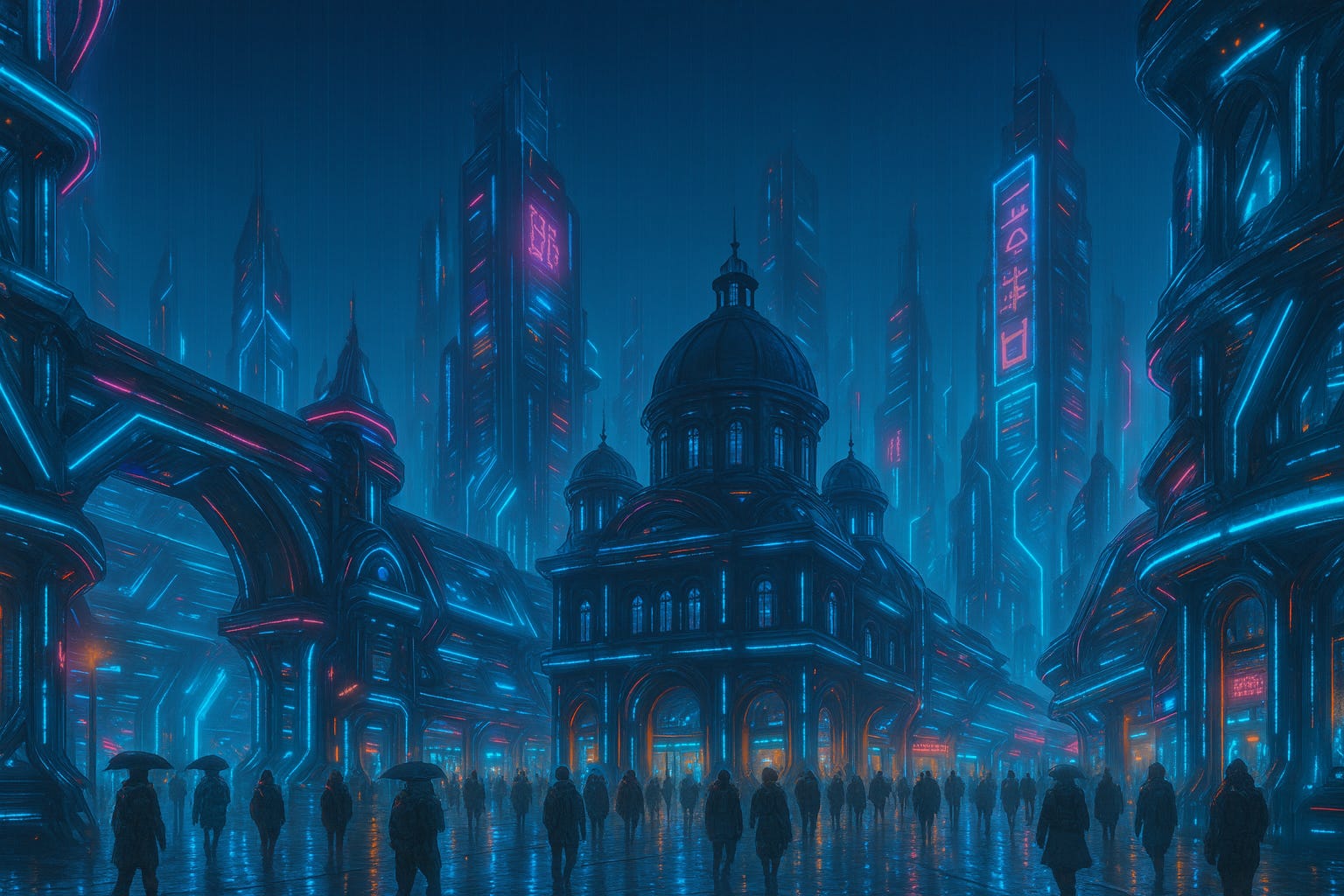
Similar to solarpunk, the focus is on advanced technology, yet its core value is the sacred, with the aim of a return (or RETͶRN) to a true tradition. Additionally, it is associated with a “based” Identitarianism: not only an embrace of ethnic identities, but also a spiritual connection with ancestry and homeland, communing together within a hierarchical order.
Faye ultimately advocated a European pagan renaissance, yet he envisioned an alliance between neo-pagans and European Christians in order to bring about archeofuturism. Given this, I see the recently built Main Cathedral of the Russian Armed Forces in Moscow Oblast as having proto-archeofuturistic vibes.
Solarpunk and archeofuturism timelines see exponential technological advancement as inevitable, but the former harnesses it with the core value of nature, while the latter does so with the sacred. Other points of contrast:
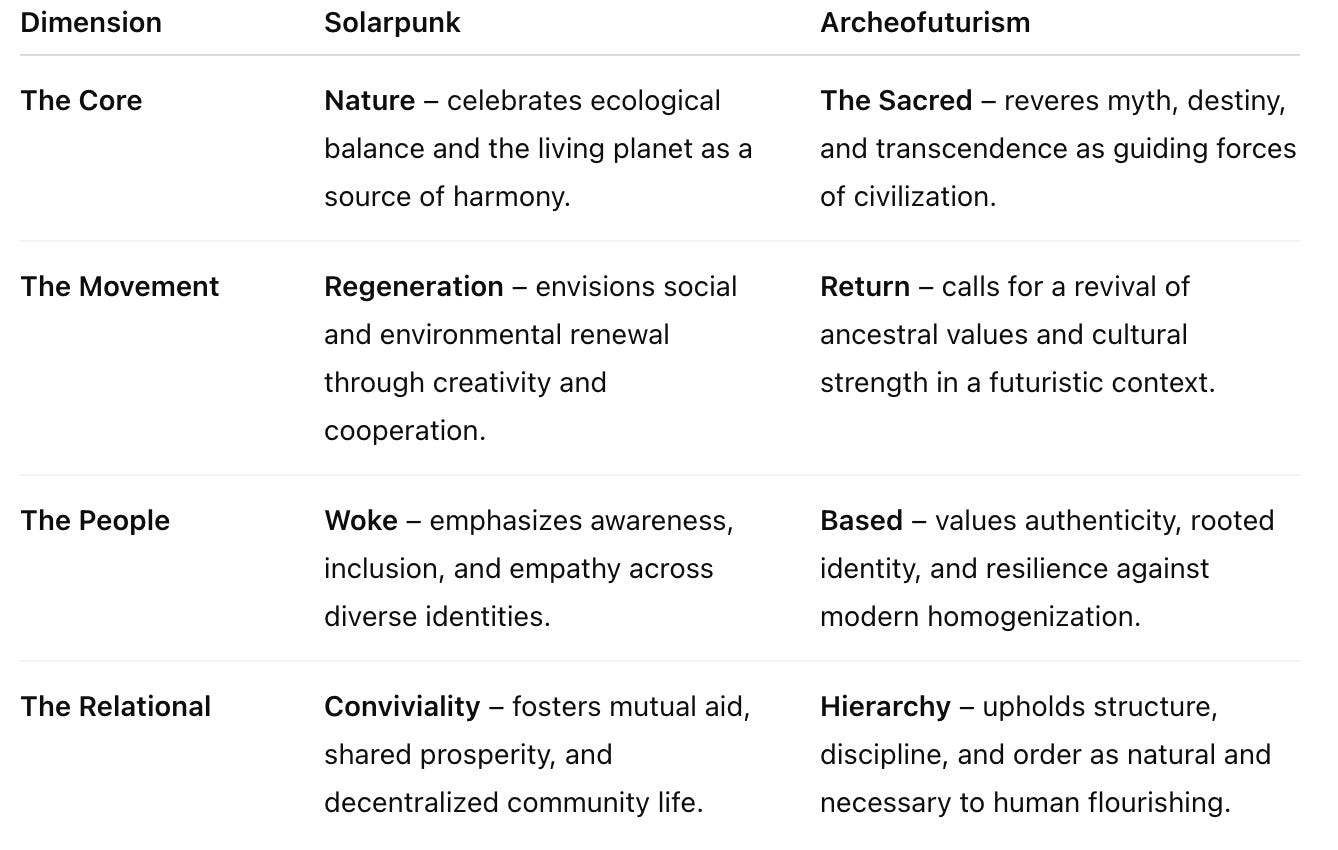
These timelines might not catch on under the names of solarpunk or archeofuturism, but I believe these imaginaries are breaking temporal boundaries, seeing beyond the event, and visually capturing the worldviews that will exist in relationship with our upcoming techno-magical world.
I wonder which one will win out.
There could be a fusion between the two. Or maybe they will coexist within separate geographies, both physical and metaphysical ones.
You already know which timeline resonates with you most.


Be sure to follow The Stoa’s Metalabel page here for upcoming experiences and join the Worldview Studies experience here.