Taste: The Ability To Recognize What’s Beautiful

“Think of your taste as an ability to recognize what’s beautiful, and your style as the way you apply your taste.” - Marty Neumeier

In writing a “Taste 2025” entry, where I list the cultural artifacts that resonated with me this year, I started becoming curious about what taste actually is. This led me to the quote above, which in turn led me to amateurly theologize about beauty itself.
*** Puts theological seatbelt on ***
When sensing into beauty, I am favourable to the transcendentals (see “Mystical Philosophy”), namely Goodness, Truth, and Beauty, the fundamental features of reality, understood through patristic metaphysics as God’s uncreated energies.
To recognize Beauty is to experience a full-bodied, resonant awareness of God’s divine harmony, a phenomenological aftertaste of the Good and the True as they shine through creation.
Since God is love (1 John 4:8), beauty may partly be understood as God’s love experienced with one’s full being, a love that moves through an artist to their art, allowing it to move to the hearts of others.
Learning to appreciate true art, and thus true Beauty, can refine our ability to know what is Good and True, granting a subtle sensitivity to the invisible vector that draws all things toward their wholeness.
The Neumeier quote is correct: taste is recognizing Beauty, and style is expressing it. The better your taste becomes, the better your style can be.
The true philosopher, the lover of wisdom, or “artist of life,” as Pierre Hadot puts it, requires this quality of stylishness in order to move through the world with loving wisdom.
Being stylish in this deeper sense is also one of the most Christian things you can do.
“Whoever wants to become a Christian must first become a poet. The soul must learn to love everything beautiful.” - St Porphyrios of Kavsokavilia
Amen.
*** Takes theological seatbelt off ***
I am looking for a life practice to develop better taste, and a very simple one dawned on me, one that everyone already does: create “Best Of” entries of artifacts that personally resonated, such as films, shows, albums, and perhaps the finest of all artistic genres, slide presentations.
And no one does slide presentations better than The Stoa. 😉
This practice is not meant to make you a “taste-maker,” someone who treats their present recognition of what is beautiful as objective, implying they have already attained good taste, if not the best taste, and who then aims to shape the wider culture with it.
Instead, it should make no claims about your present taste and, by openly setting out to become better at having taste, acknowledge that yours needs improvement.
More nobly, perhaps, such taste-cultivation is required to fight against The Sloppening.
Knowing you will be writing such lists, perhaps at a regular interval, encourages you to seek out beauty-inducing art created by actual humans, rather than mere entertainment or, worse, the bombardment of slop that is upon us.
Choosing to watch an artsy film on MUBI, for example, rather than a reality television show on Netflix or AI slop from the nearest feed, requires more attentional effort. A good film demands more of you: it is subtler, less immediately stimulating, and leaves you with a richer emotional complexity to sit with instead of a one-dimensional emotional arousal to indulge in or a mindless compulsion to void out with.
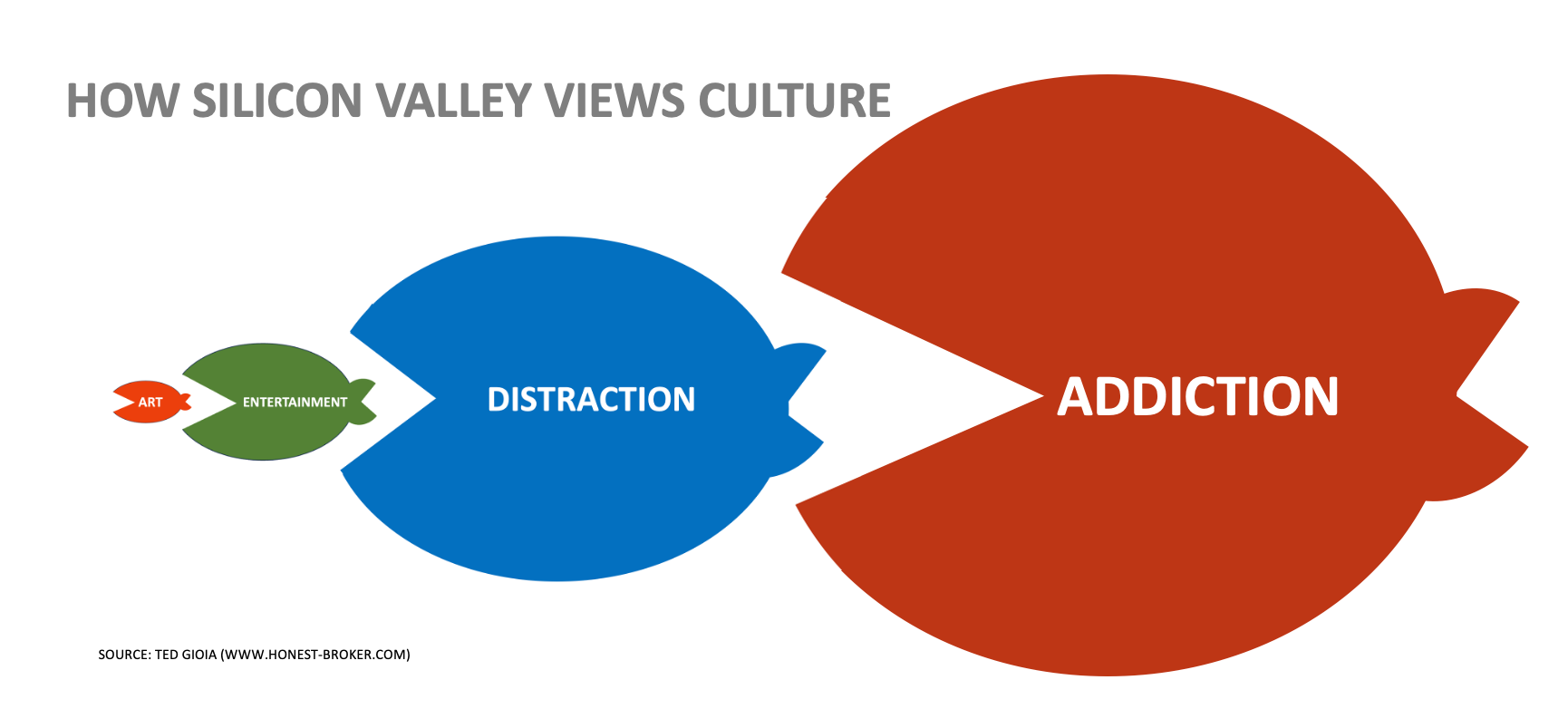
Art affects you such that you resonate with the whole, entertainment attracts you toward the excitement of a “part” (a subpersonality)1, while slop distracts you until you succumb to the void2. Or, put simply: art is divinely human, entertainment is creaturely human, and slop is uncannily inhuman, a complete absence of the other.
In any case, putting all these fancy justifications aside, it’s just fun to create a Best Of list.
I’ll share mine next week.

A helpful distinction related to art versus entertainment, gleaned from evolutionary biology, is the difference between what is beautiful and what is hot. Beauty calls forth love, leading to graceful transformation toward the whole; hotness entices one toward sex, leading to the pleasurable stimulation of a part, namely a sexual organ.
Ted Gioia is excellent here in naming the “post-entertainment culture”: